Category Archives: Faith

Love Wins – Rob Bell

Love Wins BookDeciding to blog on ‘Love Wins’ was easy. Deciding what to say about it was a lot harder. My process for blogging is this. I generally choose a book I’ve already read. I then read it again quite carefully and place little coloured stickies at the points I think are interesting and quotable. At this stage I usually have about 8 or 9 bits of coloured paper sticking out the side of the book. But, as you can see, I kept on marking the book and in the end sort of gave up. Every page seemed to have something important and interesting to say.

Having said that, I need to mention what is not in the book. It caused a bit of a stir. Rob Bell was accused of being a heretic and a false teacher. In the end he had to leave the church he had founded and move to California. He was also accused of being ‘politically liberal’ and a ‘universalist’. This side of the Atlantic being politically liberal could be seen as a compliment (certainly in our family) but being a ‘universalist’ will need to be explained.

In my post on ‘A New Kind of Christianity’ I looked at the orthodox Christian view of where people end up after they die. To recap: If you believe in Jesus then you will be saved by him and go to Heaven. Otherwise you go to Hell. It is not altogether clear what Hell is but it is very unpleasant and goes on forever. Rob Bell tackles this head on with the example of a 15 year old boy who died an atheist. In the orthodox Christian message he goes to Hell. That’s it. Some people believe there is an ‘age of accountability’ that is around the time a child is twelve years old. Bell says:

This belief raises a number of issues, one of them being the risk each new life faces. If every baby being born could grow up to not believe the right things and go to hell forever, then prematurely terminating a child’s life would actually be the loving thing to do, guaranteeing that the child ends up in Heaven, and not in hell, forever. Why run the risk?

And that risk raises another question about this high-school student’s death. What happens when a fifteen-year-old atheist dies? Was there a three-year window when he could have made a decision to change his eternal destiny? Did he miss his chance? What if he had lived to sixteen, and it was in that sixteenth year that he came to believe what he was supposed to believe? Was God limited to that three-year window, and if the message didn’t get to the young man in that time, well that’s just unfortunate?

When I read this book again, I can see why it made people angry. It starts with a blistering list of questions, tearing apart the traditional idea of who will get to heaven and who won’t. If that was at the base of my faith, I would be angry too.

But one of the main reasons for our understanding of Hell may simply be a misunderstanding of the original Greek text. Right at the end Matthew Chapter 25: 42-46 Jesus says this:

For I was hungry and you gave me nothing to eat, I was thirsty and you gave me nothing to drink, I was a stranger and you did not invite me in, I needed clothes and you did not clothe me, I was sick and in prison and you did not look after me.

They will also answer, ‘Lord when did we see you hungry or thirsty or a stranger or needing clothes or sick or in prison, and did not help you?’

He will reply, ‘I tell you the truth, whatever you did not do for one of the least of these, you did not do for me.’

Then they will go away to eternal punishment, but the righteous to eternal life. (New International Version)

Now how I, and I would guess you too, read the phrase ‘eternal punishment’ is some terrible painful punishment going on and on forever without even death to end it, because you are already dead. OK. Except it seems that is not what Matthew meant at all. Bell says:

…the story Jesus tells in Matthew 25 about sheep and goats being judged and separated. The sheep are sent to one place, while the goats go to another place because of their failure to see Jesus in the hungry and thirsty and naked.

The goats are sent, in the Greek language, to an aion of kolazo. Aion, we know, has several meanings. One is “age” or “period of time”; another refers to intensity of experience. The word kolazo is a term from horticulture. It refers to the pruning and trimming of the branches of a plant so it can flourish.

An aion of kolazo. Depending on how you translate aion and kolazo, then, the phrase can mean “a period of pruning” or a “time of trimming”, or an intense experience of correction.

Which makes perfect sense. Because people who are unkind, selfish or even cruel will never be able to flourish in the Kingdom of God. They will first need to change. It also makes sense because this is what God is like. Not a soft pushover, but always giving people a second chance. Another thing strikes me about this story: The ‘sheep’ who ‘receive their inheritance’ are not defined as ‘those who believe in Jesus’ but those who are kind and generous. It is clear from the story that they may not even realise they are doing these things for Jesus at all.

At the start of this post I promised I would explain what Universalism is. It is this: that everyone, of every faith; however sinful they are, can eventually be reconciled to God. I honestly think that it will always be harder for those who don’t accept the grace and forgiveness that Jesus offers, but the gate is open. There will always be second chances.

But what Jesus did was a whole lot more than that. Bell says:

Jesus, for these first Christians, was the ultimate exposing of what God has been up to all along.

Unity.
To all things.
God is putting the world back together,
and God is doing this through
Jesus.
 
 
He holds the entire universe in his embrace.
He is within and without time.
He is the flesh-and-blood exposure of an eternal reality.
He is the sacred power present in every dimension of creation.

Which is mind blowing but also a bit hard to grasp. So, I created a couple of pictures using my Three Worlds framework to try and explain this.

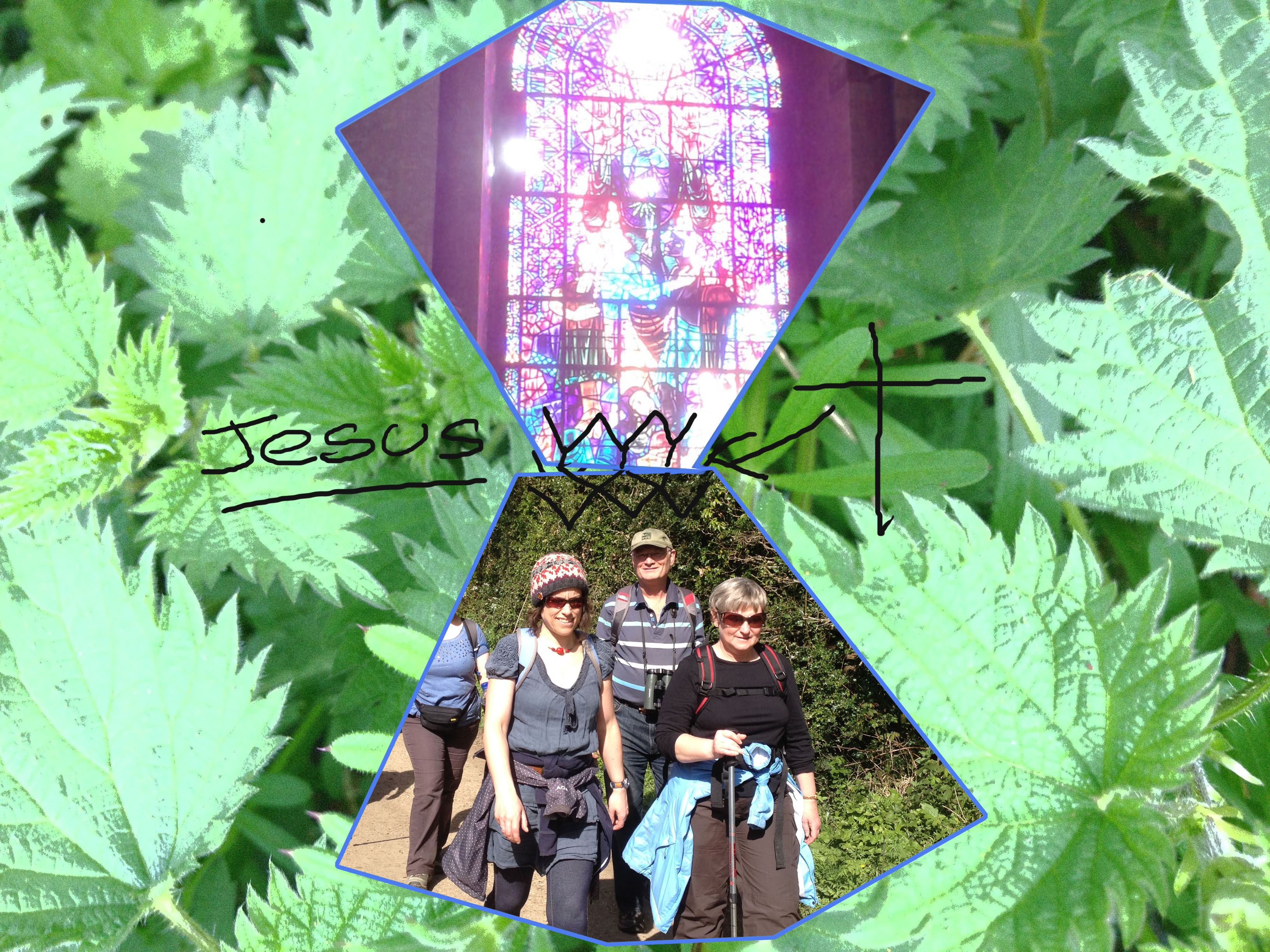
The leaves in this picture represent the physical world we live in. The people walking represent us and also the social world of friends, family and even enemies. The stained glass window represents God and His Kingdom. Before Jesus came this was the picture. There were ways of reaching God: through sacrifices, priests and a few prophets. But you had to be the right person at the right time in the right place. God was in charge, but, for most people, most of the time he was a long way off.

Broken world

We start our year counting at Jesus’ birth, but this is wrong. The first day is the Sunday when the two Marys find the empty tomb. From then on nothing is the same. God’s world and our world are knitted together. Everyone who believes in Jesus can live in both at the same time, can be a child of the world and a child of God. On that first morning everything had changed.

Healed world

Love Wins.

Three Worlds

Start

When I was reading ‘A New Kind of Christianity’ it occurred to me that we need a new way of thinking about the world. A way that includes God. This sort of bothered me. My ‘light bulb moment’ happened standing in a supermarket queue (I don’t think anyone noticed). It was not a new idea for me, I’d explored it before as a way of thinking about some of the gospel stories but I realised I needed to lay it out as an idea on its own before looking at the implications. I’ve called it ‘Three Worlds’. And here it is.

World 1

Patterns I’m sitting at my desk, looking out the window; its been raining and there are spots of water on the window. These are all real physical things. World one is the physical world we move around in. What we can see, touch, feel, smell and taste. Yet this is not a simple thing. When I look out the window each tree is a different colour and the pattern of leaves is different. And how we experience the physical world is different for each of us. On my pilgrimage last month, I just wanted to look at everything, some people wanted to touch things. Others were concerned with signs and symbols. For many people the overwhelming experience was what was happening inside their body. Blisters, aches and pains, were taking up front space in their minds. Science is discovering more and more about our physical world. I honestly believe that some of these give us a clue to the mind of God. He cares about our physical world. He made it beautiful.

World 2

World 2 is the social world. We need to live in a world connected to others. Loneliness is a terrible thing and can cause illness and even death. We understand this world instinctively as clearly as the physical world we live in.People talking I’m thinking that one of the reasons why social media is so important in our society is that it is an attempt to recreate the village communities that we have lost. It is said that in one day a modern person sees more people in one day than someone living 150 years ago saw in a lifetime. So creating and maintaining communities of people who really care about and for each other is incredibly hard. Yet this is what we long for. The picture here is of some of the people on our pilgrimage after a private church service. We all had something to say, a connection to be made.

We also make connections to animals, places and even objects. One of my friends is always telling me to ‘declutter’. ‘What can you possibly need with all those books?’ she asks. I’m not sure she understands!

World 3

World 3 is God’s world. Jesus called it the ‘Kingdom of Heaven’. We might call it the ‘Spiritual dimension’. In my very first post on this blog I talked about our nine senses. To recap these are:

  1. Sight
  2. Hearing
  3. Taste
  4. Touch
  5. Smell
  6. The sense of the inside of our bodies.
  7. The knowledge of our own thoughts.
  8. The reasoning or judgement on these thoughts.
  9. The sense of the presence of God.

And, just as almost everyone can see, it seems that almost everyone can sense the presence of God. There is even a word for the presence of God in the everyday world – Numinous. I’m going to quote Alister McGrath for a definition of this word:

“numinous” – a mysterious and awe-inspiring quality of certain things or beings, real or imagined, which (C. S) Lewis described as seemingly “lit by a light from beyond the world”.

We sense this in the beauty of the natural world, in art, in the love we feel and receive from other people. For half my adult life I was an atheist but I was still moved by religious music. My heart knew that it was telling me something important and real even if my head didn’t understand it. More than anything else this presence of God in the world shows His generous nature. Everyone has access to his presence in this way even if they don’t believe in him.

From time to time God seems to break in and act in a more direct way. These are not necessarily true miracles, but they are experiences and events that cannot be explained in any other way. The tendency of our secular world is to do exactly that even if it means calling otherwise sane and rational people deluded. But if we accept the reality of God’s world it means that the world we see, feel and talk about makes a whole lot more sense.

Three Worlds together

The idea behind these three worlds is that they create a framework to understand the whole world we live in. What I’m hoping to do is to use this framework to think about all sorts of things. I’m going to go back to the start of my journey with God and look at Chaos Theory (Yes, really) and look at how we can understand some of the Gospel stories better using this framework. I’m not sure where we will end up. It should be interesting.

Suggested Reading.

‘The Book of Sparks’ by Shaun Lambert. The quote is from ‘C. S. Lewis, A life’ by Alister McGrath.

A New kind of Christianity – Brian Mclaren

Introduction

It is now quite a long time since a did a post on a book. And quite a lot has happened. After I had written this post I realised that it contains as many of my own ideas as those of Brian McLaren. If you want to know more of what he thinks then I would really recommend reading this book. I’m sure that he won’t mind me using his ideas as a springboard for my own…

What do we believe?

When I am sitting in church do I know what the person sitting next to me believes? I will almost certainly know their name, usually their occupation and the details of their family. I may well have sat in their house and eaten food they have cooked but do I know what they believe? There is a well known saying here in England – ‘Never talk about politics or religion’ and generally we don’t. This is not helped by belonging to an established church which tries to be relevant to as many as possible. The mission statement of the (local) church I belong to is:

Building a community to reach a community with the love of God.

Which is great, fantastic and most of us are doing our best to live this out. But it is more about what we do rather than what we think. Of course the two are connected. My recent posts on pilgrimage show that what we do can change who we are and even what we believe. Maybe, as McLaren says, we need to get past this, to emerge into an ‘Age of the Spirit’. As he says:

… an approach to Christian faith that tries to preserve the treasures of previous eras and face and embrace the challenges of the twenty-first century. So something is happening. Something is afoot. A change is in the wind

But first we need to be clear about what we are leaving behind. For many people this will be quite a wrench.

timeline
This timeline is taken from McLaren’s book (I couldn’t resist adding some pictures of my own). This is the classic ‘Christian’ story. It goes something like this:

Once we were innocent. We lived in a wonderful garden and talked with God all the time. Then Eve (naughty woman!) ate the apple and gave some to Adam. They were expelled into some bleak place and there they (we)stayed until Jesus came along and saved them (us).

At this point we were given a choice. Either believe in Jesus and then, after you die, you will go to a good place called Heaven or don’t believe and then (also only after you die) you will be in Hell forever, without any time off for good behaviour. Put as bluntly as this it not only makes little sense it also seems profoundly wrong. Lets start with Eden and the fall. McLaren says:

… the Genesis narrative sets the stage for what follows. As we’ve seen. it’s the story of a good creation, marred by expanding human evil, countered by divine faithfulness, leading to profound reconciliation and healing. This narrative serves as a kind of fractal for the (bible) story as a whole and for its many parts.

Last summer I spent a week in Oxford studying Christian apologetics. One of the many memorable conversations I had there was with a young (only 19) American lad called Drew. He said: ‘How do you explain the Fall with evolution and all that?’. I thought about this. ‘Well,’ I said, ‘Who is the most fallen person you can think of?’. After a pause I came up with my own idea. ‘Gordon Gekko‘. The mythical antihero of Wall Street has no morals, no scruples, for him greed really is good.

‘So,’ I explained. ‘You have Jesus at one end of ‘falleness’ spectrum and Gordon Gekko at the other end and most of us somewhere in the middle. As society expanded it became more and more possible to ‘work the system’. Living in small family groups or villages it is hard not to be honest and upright as everyone is looking out for each other. But when people began to live in larger and more complex societies it is possible to use power to get your own way, to trample on those weaker than you.’

I had never considered this question before but I think my answer was broadly right. The story of Jewish/Christian faith covers a large chunk of human civilisation from about 3,000 BC until the present day. McLaren shows us the step changes in civilisation, each with advantages but each moving further and further from a more innocent past. This past is quite close to our own English myth of the happy and well fed farmer untainted by the delights of the big city. The story of Adam and Eve is really an ancient parable. All knowledge, all progress, comes at a price.

Here is where the conventional narrative becomes a bit confusing. We have to move from a ‘us’ story, involving everybody to one concerning each individual soul. Many of us, as Christians, are locked into a story where we have to reach a certain stage in our faith before we die so we can be in the good place. If we don’t reach that stage, if we are still confused or uncertain then we may go to the bad place after we die.

Except Jesus never said that. When he talks about Hell he uses the word Gehenna. When he talks about Heaven or (more usually) the ‘Kingdom of Heaven’. It is as something present and real, that we can be living in right now not just after we are dead. Gehenna was the Jerusalem rubbish dump and we have all been there. Unhappiness, poverty, hopelessness can all seem just like a rubbish dump. I watched a TV news slot about the war in Syria last week. It looked about as close to Hell as you can imagine but this was really happening, right now and, as the camera moved through the bombed buildings, a woman with a small child ran across the blasted, empty street.

What about other people?

And this story of Heaven and Hell doesn’t make Christians look good. About 13 years ago, when I was a very new Christian, I worked with a lovely man who followed the Sikh religion. We had some long conversations about our faith and what it means to us which were really interesting and fruitful. But then he asked THE QUESTION: “What will happen to me after I die?” I answered “You will go to Hell, because you don’t believe in Jesus”. I’m ashamed to say that I said this without the slightest hesitation, not even feeling guilty afterwards. My only excuse was that this was what I had learned from my two or three years as a Christian. I really hope he didn’t take me seriously.

McLaren addresses the ‘other religion’ question in some detail. After a 4 page tour through the old and New Testaments he says:

We would eventually need to look at Jesus, considering in detail, say, his attitudes towards a Samaritan woman, or a Roman centurian, a Syro-Phoenician woman, or some Greeks who wanted to see Jesus and went through Andrew and Philip. We could even look at Jesus’ birth narrative in Matthew, noting how the Magi – what we might call New-Age practitioners – are drawn to Jesus through their own religious arts.

As in so many other things, we need to see Jesus not as a rule giver (although there were a few) but as a living parable. As C.S Lewis put it ‘A true Myth’. In a society and culture that shunned and feared outsiders, Jesus and his followers reached out to others and respected their views. In a way this is easier in Britain than in other Western countries such as the U.S.A because we are just so diverse. It is quite difficult to feel badly towards someone of a different faith, nationality or sexual orientation if they are living next door to you or sitting at the next desk. Once you start speaking to people their lives start to be interesting and rich rather than just alien.

But, if you are reading this as a Christian, by now you will be shouting at the screen “John 14:6-7!!” For those of you who can’t recall the bible just by the book and verse (I can’t either) this is:

Jesus said, “I am the Road, also the Truth, also the Life. No one gets to the Father apart from me. If you really knew me, you would know my Father as well. From now on, you do know him. You’ve even seen him!” (Message Version)

This is where Brian McLaren and myself will need to differ. McLaren wraps this around in the context of Jesus’ coming crucifixion, resurrection and the anxious questions of his followers. This is fair enough but I think we have to assume that if Jesus said it and John wrote it down then it has got to have a wider application. I completely agree with him that this does not mean that people of other faiths or none are automatically on that mythical rubbish heap, either before or after they die, so how should we look at this?

The clue is at the other end of John’s Gospel: John 1:12-13:

Yet to all who did receive him, to those who believed in his name, he gave the right to become children of God –   children born not of natural descent, nor of human decision or a husband’s will, but born of God. (NIV)

Belief treeThis diagram shows a number of relationships we can have with God. I’m going to be bold here and say that only Jesus Christ can offer us the relationship in the top layer. Which seems like a wonderful thing, and it is, but it carries with it a responsibility. If one of my own parents requires something from me I will do it if I possibly can and there is a bond that cannot be broken. So it is with God.

But not all Christians are at this stage. And that’s OK. And followers of other faiths are relating to God in whatever way their culture and personalities will allow. There are a lot of people who believe in God who don’t follow any sort of religion, who simply think he is there. I’ve called these ‘Onlookers’. There are also people who believe in God but are angry with him, some ‘atheists’ seem to be a bit like that.

I think God honours all of these relationships. There may be a point (perhaps after we die) when we see clearly the truth of who God is. If this is so then some of these people will have a big surprise and I’m sure we will all have to adjust our thinking. I’m going to end with a parable of my own, hope it helps:

There was once an girl, about 12 years old, who was put up for adoption. The prospective parents were extremely wise, loving and patient and took time to get to know the child. The girl had very mixed feelings. On the one hand she didn’t quite trust these people. Why did they want to love her so much? What was in it for them? On the other hand she was a bit afraid. They had a lot of other adopted children already who all seemed to have their lives sorted out. What if she just wasn’t good enough?

She realised that she had a choice. She could walk away and never see them again. They had said that she could change her mind at any time but what if they rejected her?

She could maintain contact and call on them when she needed support. This seemed like a good, safe option but it was a bit scary to be out in the world on her own and what if they ignored her when she called?

She could go and live in their house, follow the rules. She would pick up her clothes, do the washing up when asked and go to school on time. If she was good and polite they would look after her and keep her from harm.

Or she could really join the family and become their child. The prospect seemed very attractive and fun but all her old fears came back. What if they didn’t love her back? What if she wasn’t good enough?

So, in the end she decided to opt for the third option. She lived in their house and did what she was told and they loved her as much as she would allow. And because the parents were extremely wise and loving they waited.

Suggested Reading

I would really recommend reading the starting point for this blog: A New kind of Christianity by Brian McLaren. It is completely packed with ideas about faith, Jesus and God.

The best two books written about Heaven and Hell are by C. S. Lewis:

The Great Divorce

The Last Battle

They are both works of fiction which seems quite appropriate for this topic.

Miracles – C. S Lewis and How God Changes Your Brain – Andew Newberg and Mark Robert Waldman

For me the brain is a mystery. Ever since I was a teenager I wanted to know about this strange jumble of nerves and chemicals, electrical impulses and blood that somehow results in what we think, who we are, what we decide. Twenty years later I became a Christian and the mystery deepened. Where did God fit into all of this? Were my vivid experiences of God a part of me or a part of something else?

In very different ways these two books attempt to address this issue. I have to admit I was quite excited about reading ‘How God changes your brain’. Opening up the brown package I expected to get real answers to my questions. And, in a way I did. It explains in detail the way that spiritual practice changes the function and structure of the brain. That faith, and the practice of faith calms the primitive side of us and turns up the more altruistic, empathic side. It explains that prayer and meditation can cause us to become not only less selfish but to loose our sense of self altogether. Heady stuff. Or not. Because at the core of this book is an evasion. I find it incredible that two people can spend years researching the subject of God and still not recognise His reality. Towards the end of the book Andrew Newberg says the following:

‘For those who embark on a spiritual journey, God becomes a metaphor reflecting their personal search for truth. It is a journey towards self-awareness, salvation or enlightenment, and for those who are touched by this mystical experience, life becomes more meaningful and rich.’

And for those of you who are thinking: ‘This must really mean something profound but I just don’t get it’, don’t worry it really is meaningless. Newberg and Waldman are clinging onto the Naturalistic world view for all they are worth, almost hanging on by their fingernails. Also, it is profoundly patronising for people of faith. The suggestion, which is repeated throughout the book, is that God is not actually real.  On the final page of chapter 11 (Miracles pp150) C. S. Lewis describes the dillemma:

‘It is always shocking to meet life where we thought we were alone. ‘Look out!’ we cry, ‘it’s alive’. And therefore this is the very point at which so many draw back – I would have done so myself if I could – and proceed no further with Christianity. An ‘impersonal God’ – well and good. A subjective God of beauty truth and goodness, inside our own heads – better still. A formless life-force surging through us, a vast power we can tap- best of all. But God himself, alive, pulling at the other end of the cord, perhaps approaching at infinite speed, the hunter, King, husband- that is quite another matter… There comes a moment when people who have been dabbling in religion (‘Man’s search for God!’) suddenly draw back. Supposing we really found him? We never meant it to come to that! Worse still, supposing He had found us?’

And yet HGCYB is a book with a great deal of useful information. Much of the focus of it on the practice of meditation, and how this can improve our emotional and mental health. This is an area the mainstream church has ignored. I think there is a certain fear that we may stray into Eastern or even ‘New Age’ practices. This could be the case if the focus of our meditation is internal (as with Buddist meditation)  but if we focus on God, to look outside ourselves to the divine, we will not fall into this trap. Another argument against using meditation as part of spiritual practice is that it is not mentioned by Jesus in the Gospels. This is true, but the reason for this could well be that He didn’t need to. I did a quick search of the Old testament for the words Meditate and Meditation. They came up 18 times in the Psalms alone. I like this one:

‘Within your temple, O God,
we meditate on your unfailing love.’ – Psalm 48 v 9

This, and the other verses, were something all his audience knew. Only we have forgotten.

So, how does this work? Well, about a year ago I started to pray using a form called the ‘Jesus Prayer’. As this involves actions as well as words I’ve tried to draw it below:

Jesus Prayer

The words are: ‘Lord Jesus Christ, Son of God. Have mercy on me, a sinner’. This is a very old prayer, from the 4th or 5th Century. The prayer is silent. The up stroke in the picture represents a breath in (try to breathe from your stomach, like a singer) and the down stroke a breath out. The traditional way to use this prayer is to find a quiet place, a relaxed position (I like to lie down but there is a danger of falling asleep) and say this prayer between 10 and 20 times. This may be quite difficult at first but it is worth persevering. As you continue you will find any worries fading and the barriers between yourself and God falling away. After a while God will become clearer and He will start to communicate. This may be a feeling of peace, or a great inrush of the Holy Spirit. Sometimes I am prompted to pray quite simply for people I know who are in need.

I taught this prayer to our bible study group and about two thirds of them began to practice it. One couple, who were suffering from  health problems prayed it to help them relax enough to sleep. Another lady decided she didn’t like the words and used the same breathing technique, but on the words of the Lords Prayer. I have used it in all sorts of stressful situations, even in the middle of meetings. It doesn’t always solve the problems, but I feel so calm it doesn’t matter!

C. S. Lewis takes the role of the brain in relation to God and takes a completely different tack. HGCYB sees God as a product of the Brain. Lewis sees the brain as an spearhead or incursion of the supernatural into the natural world. The argument goes something like this:

  • The ability to reason is completely unlike the rest of the natural world.
  • Also the notion of right and wrong (even when it does not benefit the individual concerned) is so strong in Human Beings.
  • Therefore it must come from outside the natural world.
  • Therefore there must be a super nature outside of nature that has created this ability.

He says:

Human minds, then are not the only supernatural entities that exist. They do not come from nowhere. Each has come into Nature from Supernature: each has its tap-root in an eternal, self-existent, rational Being, whom we call God. Each is an offshoot, or spearhead, or incursion of that Supernatural reality into Nature.

I’ve tried to illustrate this below. On this 2D picture I’ve shown God on one side and Nature on the other with the two meeting within the Human mind. But it is more like a mingling or layering. Lewis talks of another dimension. I think it would be more accurate to talk of another sense. For a number of years I lost my sense of smell. I can well remember the day it came back. Just the smell of bacon was like a whole extra layer of reality in the world. Experiencing God is like that only bigger; a whole extra sense of reality.

brain2

Before we move on to more of Lewis’ ideas about Nature and God I think it is worth pointing out that this is not a particularly easy book to read. This is not because of the language or style (which, as you can see from the extracts is rather elegant) but because of the time in which it was written. Like most books of Christian thinking it is arguing against the prevailing thinking of its day.

But ‘Miracles’ was published in 1947. This is before the theory of the Big Bang, before Global Warming (well it was happening but no-one realised it), before chaos theory or butterflies flapping their wings in China. The universe seemed a very safe predictable place. David Hume could argue without a trace of irony that miracles could not happen because it was simply so unlikely that nature could be any different tomorrow from what it was today; so improbable, that it was impossible to believe. And Lewis needed to have a counter argument to this.

But the chapter ‘On Probability’ is the last one that the reader will need to make allowances for. From then on Lewis launches into a glorious and completely unapologetic exploration of the Miracles of the New Testament. Starting with the primary miracle of the incarnation of God in Jesus Christ. Today, even Christians don’t like to examine miracles too closely. I have tried to lead discussions on the physical nature of miracles and been constantly deflected into their emotional and religious significance. But Lewis meets this challenge head on. He describes miracles as being like God reaching down directly into the world. Our God is the creator, the god of nature as well as supernature. So every birth is His work, but through the medium of the biological process. In the conception of Jesus he dispensed with the mechanism of biology and reached directly into the womb of a young Jewish girl at her prayers. Following on from his argument that each one of us has a ‘tap root’ of God within us he says:

We cannot conceive how the Divine Spirit dwelled within the created and human spirit of Jesus but neither can we conceive how His human spirit, or that of any man, dwells within his natural organism. What we can understand, if the Christian doctrine is true, is that our own composite existence is not the sheer anomaly it might seem to be, but a faint image of he Divine Incarnation itself – the same theme but in a very minor key.

So, in all miracles there is a fusion of the natural and supernatural. And in this way they are physical prophecies, precursors of a ‘New Nature’. ‘There will be no room to get the finest razor blade of thought between Sprit and Nature’ says Lewis. I think we see this at work in the Gospels many times. In the feeding of the five thousand;

“Bring them here to me,” He said. And he directed the people to sit down on the grass. Taking the five loaves and the two fish and looking up to Heaven, he gave thanks and broke the loaves. Then he gave them to the disciples, and the disciples gave them to the people. – Matthew 14: 18-19

At some point during the bread and fishes acquired a new spiritual reality. They were still loaves, still fishes, still could be eaten and digested, yet Heaven had entered that bread at that moment of giving thanks. I wonder what it felt like to eat that bread? Were those people changed by it?

But there is one thing I need to disagree with Lewis on. In many places he says that this fusion of God’s Spirit and Nature happened at one time in history. Even reading the bible this is clearly not true. There are many instances of this happening in Acts. But does this still happen today?

The answer is ‘Of Course it does’. Even among the Christians I know I can think of many instances. It is almost commonplace. But, as this is a blog rather than an academic discourse I’m going to describe something that happened to me last spring:

At the beginning of 2012 I found myself in a difficult place. I felt I was stalled in many areas of my life. My work was not going well, I seemed to be sleepwalking through both my Church and home life. During this time I had a vivid picture in my mind of being in a dark wood, surrounded by brambles and thorns. Gradually, as the days grew longer, the picture changed and I seemed to be coming to the edge of this wood. Through the brambles I could see a bright green hillside. Then the changes to the picture in my mind stalled. I was standing on the edge of the beautiful hillside; there was nothing stopping me from walking forward but I couldn’t and I could still see the brambles and thorns on the edge of my vision.

Then I became aware of God asking me to make a journey. Now this happens from time to time. The journeys are not usually very long, sometimes just to the other side of the room. The furthest I’ve ever been asked to go is Oxford (about 40 miles away). In this case it was to climb to the top of the hill near our house. Now this was not an unreasonable or difficult request but, for a few weeks, I kept on putting it off. Finally, I put on my walking boots (It’s quite a steep climb), packed my paints, and walked out of the house and up the hill.

Hillside

As I reached the top I began to realise that the landscape was actually the picture in my mind. To my right was the wood, full of brambles and thorns. To my left was a bright green hillside with wild flowers and little bushes in the distance. I sat on a bench and painted the picture you can see here. Then I packed away my paints and walked forward away from the dark wood.

It was at this point that the extraordinary thing happened. The ground under my feet seemed to have two distinct realities. It was still physical ground but it also had a spiritual reality that was hovering slightly above the solid ground. This spiritual ground was slightly luminous and even brighter than the grass in the spring sunshine. I wish now that I had been paying more attention. What was I actually walking on? If this had been water rather than ground could I have walked on it, like Peter and Jesus? I don’t know. Because what I was most aware of was a tremendous sense of peace and joy. The walk across that hillside was also a walk away from the brambles and thorns into a more positive future. I felt physically very strong and light, as though it took no effort at all to make that walk.

For someone like myself, with a scientific education, such an experience raises more questions than it answers. But I know it was not a dream or an illusion. If anything, it was more real than my everyday existence and has had a profound and lasting effect on my life. But I am going to leave the last word to Lewis:

But Christian teaching, by saying that God made the world and called it good, teaches that Nature or environment cannot be simply irrelevant to spiritual beatitude in general… By teaching the resurrection of the body it teaches that Heaven is not merely a state of the spirit but a state of the body as well: and therefore a state of Nature as a whole. Christ, it is true, told His hearers that the kingdom of Heaven was ‘within’ or ‘among’ them. But his hearers were not merely in ‘a state of mind’. The planet He had created was beneath their feet, His sun above their heads; blood and lungs and guts were working in the bodies He had invented, photons and sound waves of His devising were blessing them with the sight of His human face and sound of His voice… From this factor of environment Christianity does not teach us to desire a total release. We desire, like St Paul, not to be un-clothed but to be re-clothed: to find not the formless Everywhere-and-Nowhere but the promised land, that Nature which will be always and perfectly- as present Nature is partially and intermittently – the instrument for that that music which will then arise between Christ and us.

← Back

Thank you for your response. ✨