Author Archives: Monica's Books

Pilgrimage Diary – Shrove Tuesday

When I started this blog I never meant it to be a personal diary. I have never kept a diary so why start now? But in about a month a group of us will be walking from Reigate to Canterbury. A distance of just over 80 miles. So it seems right to record the journey to the pilgrimage as well as the event itself. I’m going to try to write something every day, however short.

So, how do I feel at the moment? Exhausted, stretched too thin, very glad to be giving up work in two weeks time. At the moment I am driving west every evening, almost along the route we will be walking. Last night I drove into huge rainclouds, with Dire Straits on the CD player. Then, when I reached Reigate Hill, the cloud broke up. This has been a very strange way to leave a job. Everyone has been very sweet and supportive which is nice and I don’t have any doubts about where I’m going. An unusual aspect of this company is that the owner sends out e-mails with words of wisdom and quotes. He seems to favour L. Ron Hubbard which is interesting. So, in the spirit of this blog my quote is a book title:

If you want to walk on water, you have to get out of the boat (By John Ortberg)

How did England lose its Faith?

To most people in this country the answer would be: Why not? We know better now than to believe all that superstitious nonsense. But I knew there had to be an answer. It just took a long time to find it.

It came to me at the beginning of the hot summer of 2011. I was called to do jury service and it was altogether an odd experience. I was warned that there would be quite a lot of waiting around so I brought a book to finish. The book was one of my favourites ‘The Varieties of Religious Experience’ by William James. So I sat on the bank of padded, but not too comfortable chairs and read. ‘What are you reading?’ The tall, thin man opposite asked. I showed him and explained it was about the way that people experience God. ‘Oh, I’m a born again Atheist’, He said, ‘God is just something you have constructed in your mind because you need an authority figure’.

Now it seems very interesting to me that someone can be so certain that something is not true. For instance, I rather like the idea of UFOs. I’m fairly sure they don’t exist but it seems intriguing  that so many people believe they do. This man (his name was Alex) had all the arguments and had obviously read ‘The God Delusion’ with attention. But what Alex, and Dawkins, never seem to take into account is that many people experience God in very direct ways. But I am getting off the point…

One major difference between doing Jury service and my normal existence was the amount of free time I had. During long lunch breaks I would wander round Guildford looking in the shops and, of course, ended up in the local bookshop. It was quite a large bookshop but had the usual measly couple of shelves on Faith matters, perhaps 100 books altogether. Many of these were arguing against God rather than for Him. Initially, the book I picked up looked as though it was one of these. It was called ‘The Rage against God‘ by Peter Hitchens. As I looked through it seemed the ideal book to give to my new friend Alex.

I never gave it to him. As I read it on the train, moving through the parched Surrey countryside, I realised it was saying something unique and important. That the English people, even while they sat comfortably in their beautiful old churches, were worshipping the wrong God. As Hitchens puts it:

I hope to show that one of the things I was schooled in was not in fact religion but a strange and vulnerable counterfeit of it, a counterfeit that can be detected and rejected while yet leaving the genuine truths of Christianity undamaged.

The relevant Bible text is from Exodus 20:

No other gods, only me. No carved gods of any size, shape, or form of anything whatever, whether of things that fly or walk or swim. Don’t bow down to them and don’t serve them because I am God, your God, and I’m a most jealous God, punishing the children for any sins their parents pass on to them to the third, and yes, even to the fourth generation of those who hate me. But I’m unswervingly loyal to the thousands who love me and keep my commandments. (The Message translation)

Which is the first commandment. Its strange really but even completely non-religious people are comfortable with most of the 10 commandments. Some are even written into law. Others, such as the prohibition of adultery, they know to be right even if inconvenient. But this first one appears to be uncompromising to the point of cruelty. I’m going to come back to this later but first I want to continue with Hitchens view of English religion. He talks of the ‘Faith in Science’:

The Christian conservatism of my schools did not protect me from the rather Victorian faith in something called ‘Science’ which was then very common. Perhaps this is because Christianity was not implied in every action and statement of my teachers wheras materialistic, naturalistic faith was. This faith did not require any great understanding. Mainly, it was just an assumption, a received opinion we all accepted.

But faith in science can only dilute and misdirect religious faith (and taken seriously it can even strengthen it, but that is for a future post…) . It takes something stronger to poison it. He comes to this in chapter 5:

Now we come to the very heart of the cult that enthralled us all, especially children… I possessed for many years a comic book biography of our Great Leader, called ‘The Happy Warrior’, one of thousands of more or less idolatrous publications which concentrated rather heavily on Mr Churchhill’s good side. I knew more about his life than the life of Christ. He was our saviour.

Hitchens describes the central ritual of the year:

As pseudo-religions go, ours was attractive and elegant, and it contained many decent and godly elements. Its central ceremony was Remembrance Sunday, the Sunday closest to the 11th of November…In the very depths of this season of universal drab coloured gloom we were marched in ranks and files down to the town war memorial, absurd caps on our heads, for the crowning ritual of the year.. A Vicar in austere black and white vestments intoned uncompromisingly Protestant prayers, we kept in silence, a quavering bugle blew, we sang ‘Oh God, Our Help in Ages Past’, a hymn that seemed to have been carved from granite much like that of the memorial itself. It was a deep evocation of everything we liked about ourselves, an indulgence in melancholy and proud self restraint. No outsider could possibly have penetrated its English mysteries, or imagined that we were, in fact enjoying ourselves. But we were.

There is a great deal more in the book about the cult of the Second world war and it is well worth reading but I will end my quotes on this subject with this summing up:

… the proper remembering of dead warriors, though right and fitting, is a very different thing from the Christian religion. The Christian church has been powerfully damaged by letting itself be confused with love of country and making of great wars.

There was a sort of double whammy effect here. On the one hand the content of what was being offered by the Church became thinner, less convincing and more boring. Also, the Church (especially the Church of England) became associated with increasingly old fashioned values. The generation born after the war wanted to move on and the Church was not moving with them.

Timothy Keller, in his book ‘Counterfeit Gods’, describes something similar happening in the USA.

Why did our culture largely abandon God as its Hope? I believe it was because our religious communities have been and continue to be filled with these false gods. Making an idol out of doctrinal accuracy, ministry success, or moral rectitude leads to constant internal conflict, arrogance and self-righteousness, and oppression of those whose views differ. These toxic effects of religious idolatry have led to widespread disaffection with religion in general and Christianity in particular. Thinking we have tried God, we have turned to other Hopes, with devastating consequences.

But, you may well ask, why didn’t I realise this? I was born and raised in England, why did I spend 15 years pondering this question? Well, I was raised in this country but my parents were not. My mother rejected the rather austere Dutch Protestantism she was raised in. My fathers parents had already ceased to be practising Jews by the time they arrived in England, from Germany in the late Thirties. As a girl, Churchill was no more than an interesting historical figure to me. The fact that ‘we’ had won the war was no more to me than a fact. When the bugle blew and we stood in silence I was remembering quite a different war.

Last November I turned on the TV on Saturday night expecting to watch the usual hospital drama. Instead there was a program from the Royal Albert Hall. Groups of various parts of the armed services were processing into the centre of the Hall with great ceremony. A Welsh newsreader was describing the function of each of these armed services with great dignity and ceremony. A glittering brass band played sombre music for the men and women to march to. It was all very touching, just like a religious ceremony. But who was being worshipped? Was it the actual men and women there? Or those who had died? Or some abstract noble warrior? Now don’t get me wrong, I have nothing against soldiers. Those who I have met are fine, courageous people and they do a difficult job. But so do a lot of people and when it comes down to it they are just people. To put them in place of God is certainly wrong.

By the time I was an adult the cult of Winston Churchill had faded but it was to be replaced by another, equally potent, figure. Diana Spencer was married to Prince Charles at 19. She was a year older than me. The summer I left school I watched her arrive at her wedding on the TV with millions of other people but she did not figure much in my life after that. When her marriage fell apart I can remember thinking how sad it was. She was badly treated, a genuinely tragic figure. So, it wasn’t until her death in 1997 that the scale of the focus on her became apparent. I remember the morning she died. We were preparing to go on holiday. I was hoping that our 3 year old son would be happy watching kids TV for an hour while we did the last of the packing. But instead of Teletubbies and cartoons there was only an endless reel of a wrecked car in a Paris tunnel. I switched the TV off and spent the next fortnight in a campsite on top of a hill in Dordogne. While we were there we found out that Diana had died and, of course, this was a big story but it wasn’t until we returned to England I realised just how big. It seemed the whole country was in mourning. I just kept quiet and watched the TV news: The weeping mourners, the young Tony Blair talking to camera, the acres of flowers outside Kensington Palace. I had started going to church the year before and there was a prophecy being spoken at our church in Reigate…

I said I would come back to the passage from Exodus. Churchhill and Diana are not the only gods revered by the English people. You only have to wander through the cathedrals dedicated to shopping or corporate success to realise that. It seems incredibly harsh for generations to be punished for worshipping the wrong god but the problem is that it is true. Sin is an odd word but, in this case, I would call something a sin that hurts other people. And we all know families that repeat hurtful actions generation after generation. It could be addiction, alcohol abuse, pride or anger. And these families can look to their ‘gods’ all they like but, you know something, they are not going to help. Some people reading this may say that God won’t either but He seems a much better bet and Jesus offers us the hard, deep magic of forgiveness that we must offer first before we receive it. In the ‘Rage Against God’ Hitchens describes a Russian society that has almost completely forgotten God. It is a bleak and hopeless picture and he says that we are heading the same way. I don’t agree.

The prophecy I heard went something like this:

Before the flowers have faded around Kensington Palace God will have started something new.

I don’t know if this was just something said in Reigate or was more widespread. At the time I dismissed it. After all there were no accounts of people flocking to Church. But, by 1998, the Alpha Course was successful enough to be described as a ‘cult’ by the newspapers, thousands of people were spending their holidays at New Wine or Spring Harvest Christian conferences,  many new churches are being started in school halls and ordinary people’s front rooms. Something was starting. The installation of our current Archbishop of Canterbury is another sign of the rebirth of Christianity in this country

But we need to be careful. Jesus did not insist on his ‘rights’. He did not define himself as better than those categorised as sinners in his society. When we define Gay people as sinners we hurt ourselves as much as them (especially those who wish to become Christians). I will end with a quote from Sir Andrew Stunell MP.

Making Christians angry is easy. Making Christians think is the hard part.

Suggested Reading:

‘The Rage Against God’ by Peter Hitchens. Well worth reading, if only for the description of modern Russia.

On Forgiveness: ‘What’s so Amazing about Grace?’ by Philip Yancey.

On modern ‘gods’ (but from an American point of view): Counterfeit Gods by Timothy Keller.

The quote from Sir Andrew Stunell from ‘Liberal Democrats do God’ – Edited by Jo Latham and Claire Mathys

If you would like to contact me directly please use the form below:

← Back

Thank you for your response. ✨

Of the hundreds of books I read as a girl there are only a handful that still sit on my shelves: Lord of the Rings, The Glass Bead Game, some of the Narnia books and this book: Jane Eyre. It is, of course, a love story. Through TV and film adaptations almost everyone knows the story: The young orphan girl who becomes a governess and falls in love with her employer. But I will leave the reader of this blog to discover that for themselves because I want to look at another aspect of this book. Hidden in its 500 or so pages are some extraordinary ideas about heaven and hell.

But first: Why talk about Heaven and Hell? Well, I said in an earlier blog that no-one wants to talk about miracles but everyone wants to talk about what happens after you die. Even people who have no intention of ever stepping foot in a church are thinking about it. (The most bizarre question I had recently was about what happens to battery chickens after they are killed. And no, I don’t know the answer). Charlotte Bronte lays bare a lot of the mythology surrounding this and, I think, gives us a better way to consider this whole question.

The book starts with Jane as a young girl being brought up by her Aunt, who dislikes her. She is introduced to the patron of a school, Mr Brocklehurst, and Aunt Reed gives him some advice:

I should be glad if the superintendent and teachers were requested to keep a strict eye on her, and above all, to guard against her worst fault, a tendency to deceit. I mention this in your hearing, Jane, that you may not attempt to impose on Mr Brocklehurst’

Well might I dread (thinks Jane), well might I dislike Mrs Reed; for it was her nature to wound me cruelly: never was I happy in her presence. However carefully I obeyed, however strenuously I strove to please her, my efforts were still repulsed, and repaid by such sentences as the above. Now uttered before a stranger, the accusation cut me to the heart: I dimly perceived that she was already obliterating hope from the new phase of existence which she destined me to enter. I felt, though I could not have expressed the feeling, that she was sowing aversion and unkindness along my future path: I saw myself transformed.. into an artful noxious child and what could I do to remedy the injury?…

‘Deceit is, indeed a sad fault in a child.’ said Mr Brocklehurst; ‘it is akin to falsehood, and all liars will have their portion in the lake burning with fire and brimstone’

So here is my quick image of the lake of fire. This is really Hell as a threat. If you don’t do what you are supposed to do then this is what will happen to you! I’m not convinced. Something in me says that Hell would not be that obvious.

cartoon hell

But hidden in this passage is another kind of hell, a much more immediate one. I drew the picture below for a study we did about a year ago on the parable of the Sower. The parable is about the word of God. It falls on different sorts of ground, and some falls among weeds and thorns. In Matthew 13 Jesus explains this:

22 “The seed cast in the weeds is the person who hears the kingdom news, but weeds of worry and illusions about getting more and wanting everything under the sun strangle what was heard, and nothing comes of it.

inthorns

Jane, in her childish way, is internally voicing a fear that many of us have: That we will be unable to escape our past, that sins and injustices, real or imagined, will follow us wherever we go. That the small green shoots of a new life, a new start, will be strangled by what we have brought with us from our life before. Recently I said that I did not believe in Hell. ‘What do you mean by Hell?’ I was asked. ‘A sort of cartoon Hell with fire and brimstone’, I answered. But I do believe in the kind of Hell that Jane imagines, a hovering of fear over everything we do.

 And for a while, after she goes to school, this fear seems to be realised but two people come into her life who change her views. The first is a kindly teaHelen Burnscher called Miss Temple. The second is a slightly older girl called Helen Burns.

Helen seems to have an almost supernatural ability to put up with difficulties and forgive those around her. She is constantly accused and punished for the slightest transgressions, yet accepts this without complaint. As Jane gets to know her one thing is clear. Helen is dying. A fever breaks out in the school she attends but Helen is not dying of Typhus, she is dying of consumption and she has known for a long time. In the middle of the night Jane wakes up and feels that she must go and visit Helen. As it is a cold night she gets into bed with her to keep warm. Then they have the following conversation:

“I am very happy, Jane; and when you hear that I am dead, you must be sure and not grieve: there is nothing to grieve about. We all must die one day, and the illness which is removing me is not painful; it is gentle and gradual: my mind is at rest… By dying young, I shall escape great sufferings. I had not qualities or talents to make my way very well in the world: I should have been continually at fault.’

‘But where are you going to, Helen? Can you see? Do you know?’

‘I believe; I have faith: I am going to God.’

‘Where is God? What is God?’

‘My Maker and yours who will never destroy what he has created. I rely implicitly on His power, and confide wholly in His goodness: I count the hours till that eventful one arrives which shall restore me to Him, reveal Him to me.’

‘You are sure, then, Helen, that there is such a place as heaven; and that our souls can get to it when we die?’

‘I am sure that there is a future state; I believe God is good; I can resign my immortal part to Him without any misgiving. God is my father; God is my friend; I love him; I believe he loves me.’

‘And shall I see you again, Helen, when I die?’

‘You will come again to the same region of happiness: be received by the same mighty universal Parent, no doubt, dear Jane.’

There seems little need to comment further. If we trust God then we must trust him to look after us after we die. We do not know, cannot know and, perhaps, should not know exactly what heaven will be like. If I live out an average lifespan then I have about another 25 years on this earth and I don’t feel any need to rush towards my end. After all, with all its difficulties and challenges, God has put me here. I shouldn’t throw it away. But, I’m not afraid of death, or only in the way that we are afraid of anything new that cannot be altered.

Jesus has very little to say about  it. Only when he is nearing his end he says (John Ch 14 – The Message):

‘Don’t let this throw you. You trust God, don’t you? Trust me. There is plenty of room for you in my Father’s home. If that weren’t so, would I have told you that I’m on my way to get a room ready for you? And if I’m on my way to get your room ready. I’ll come back and get you so you can live where I live.’

But I don’t think that God’s home will be like a large hotel with a discreet manager catering for our every whim. He will be more like a generous host, present in everything, reaching out to all his guests. And there lies the problem. Because, what happens if you have spent your whole life sneering at Him, thinking you are better than Him, or doing your very best to ignore His existence? What happens if you are so ashamed of who you are that you have tried to only show your ‘best’ side to him? Jesus tells a few stories about God inviting people to a feast and all the good, respectable people giving their excuses and not turning up. These same good, respectable people who couldn’t bear to be with God while they were alive will suddenly be face to face with him. Its going to be pretty uncomfortable to be living in his home, in his presence every minute of every day.

I’m sure I will return to this theme but, to complete Charlotte Bronte’s vision of Hell and Heaven, we must speed forward in the book to Jane as an adult. She is living with a family of two sisters and a brother. She has discovered that this family are actually her cousins. But rather than settling down to a comfortable life with them she is presented with a dilemma: Should she marry her cousin and go with him to be a missionary in India?

St John Eyre Rivers must be one of the most interesting characters in 19th Century fiction. He is intensely religious but not spiritual. He appears to be more concerned with those on the other side of the world more than the people around him. He wants to do good but is prepared to destroy Jane, both physically and emotionally, in the process. As the daughter of a clergyman Charlotte Bronte must have known people like this. Indeed, to me, this has the ring of truth. There are many people, inside and outside the Church, who feel that the best way to do good in the world is to leave the world they know and enter another. Maybe they are right for themselves but ,like Jane, I feel rather uncertain about this. But I know two things: Anywhere in the world there is good to be done (however outwardly comfortable it seems) and to do good without wanting to, without Joy, is a lifeless and almost cruel thing. He is described thus:

… he seemed of a reserved, an abstracted, and even of a brooding nature. Zealous in his ministerial labours, blameless in his life and habits, he yet did not appear to enjoy that mental serenity, that inward content, which should be the reward of every sincere Christian and practical philanthropist.

For him Heaven can only be reached through Hell. He will be given his ‘reward’ only if he first denies himself every softer human quality. You have to ask yourself what kind of room Jesus will be preparing for him. Maybe a bare monastery cell, if he’s lucky!

There is a lot of nonsense talked about life after death and I hope I’m not going to add to that. But on the other hand there seems no harm in playing around with ideas on this topic, just as long as we don’t think we know anything for certain. But first I have a personal admission to make: I know a lot about computer systems. Not the sort of systems that run the laptop I’m writing this blog on, or the WordPress software that is publishing it out to the net but big corporate database systems. And very strange things they are. For a start they are never switched off. Also, the system the office users see is completely different from the system I see, which consists largely of patterns of data. And there are other people, who look after the low level functioning of the database and servers who see yet another side which is mostly composed of processes which move the data from one place to another. So, like a living thing the whole system is constantly changing and working, even when no-one is using it. Even when it is ‘down’ the core of it is still functioning.

So, why does this matter to our thinking about life and death? Well, because last week we copied this system from one physical computer to another. We took an image of the essence of the system and put it in a file. This image couldn’t do anything, it was essentially dead. We then copied this into a working system which ran exactly like the one we had copied it from, but it was on a different physical computer, in a different building. For the computer system this was quite a traumatic process. It was unable to communicate with the outside world for a couple of days. For a short while it had no data at all.

Metaphors are dangerous things and I don’t want to push this too far but it seems to me that (from the clues in the bible) this copying process is a lot like what happens when we die. Luke Chapter 20 says:

34 Jesus replied, ‘The people of this age marry and are given in marriage. 35 But those who are considered worthy of taking part in the age to come and in the resurrection from the dead will neither marry nor be given in marriage, 36 and they can no longer die; for they are like the angels. They are God’s children, since they are children of the resurrection. 37 But in the account of the burning bush, even Moses showed that the dead rise, for he calls the Lord “the God of Abraham, and the God of Isaac, and the God of Jacob”.[a]38 He is not the God of the dead, but of the living, for to him all are alive.’

So, we will have a new type of body, be ‘like the Angels’. The only account we have of this kind of body is that of Jesus himself. When he came back from the dead he could appear and disappear at will, He was clearly different yet was also ‘himself’. If we are to continue after our own deaths then, however different we are, some essence of ourselves must continue. And just like my computer system that essence can only be transferred at the moment of our death. This means we must be more like Helen Burns than St John Rivers. It is what we are, not what we do that matters, if we are to meet God in his home.  One of my favourite Christian songs is ‘Dance’ by the Newsboys. This seems to put it perfectly:

Faith is the substance
Faith is the key
Faith is gonna take us
Where we’re meant to be

So, if we believe, really believe in God; If we trust, really trust in Jesus then we will be changed by Him. Then what we do will always be right because it will come out of who we are. Then it won’t matter if we get to Heaven because we will already be living in the Kingdom of God.

Postscript

Firstly I want to apologise to anyone who was expecting the next blog to be on ‘Mind and Cosmos’. I will get back to that, but not just yet.

Recommended reading:

If you have never read ‘Jane Eyre’ (or only been forced to do so at school) then I would really recommend doing this. The book has a lot more in it than any of the film/TV adaptations. For those of you who prefer to listen to your books there are some very good audio versions available.

‘Love Wins’ by Rob Bell. Brilliant, controversial and very readable. Surely the rewriting of this theology for our age.

The next post will be on ‘The Rage against God’ by Peter Hitchens, and why England is now a secular Nation.

And finally, If you want to reach me leave me a message here:

← Back

Thank you for your response. ✨

Mind and Cosmos – Thomas Nagel – Part 1

I do not often feel sorry for the authors of books I read. Indeed, to have a book published is a fine thing. And Thomas Nagel is a Professor at the University of New York, while I’m just a humble blogger. But, as I read it, I did feel sorry for him. Because to challenge the current scientific view without straying into theology is hard,  very hard. He makes a good effort but it doesn’t altogether come off.

Because Professor Nagel has one serious problem and that is a lack of faith. Obviously, as an atheist, he lacks faith in God. Early on in the book he states:

…theism – which is to be rejected as a mere projection of our internal self-conception onto the universe, without evidence.

But he also lacks a faith in science. Now, faith in God and faith in science are very different things. What I mean by faith in science is an understanding that, even if we don’t understand how things work now, this doesn’t mean that we won’t in the future. Early on in the 20th century the prevailing view was that almost everything scientific was known, or soon would be. More than a century later we wouldn’t dream of thinking such a thing. This is especially true in the study of the brain. Until fairly late on in the 20th century the only way to see inside the brain was to cut it open. Now we have imaging techniques which allow us to see what the brain is doing in a general way but these are far from perfect. Nagel’s view is, because we have no scientific explanation for how the physical workings of the brain translate into actual thoughts, ideas and awareness (consciousness) it is not possible that there can be one.

I don’t agree. You are reading this page on a screen made of millions of individual points of light. The information is held on a database on a huge server somewhere in the world. Yet it (hopefully) makes sense to you. This is called emergence. The ideas and words emerge, not just from the technology but also from our understanding of language. So, out of this strange collection of squiggles on the screen your mind can make sense of what I am trying to say. In a way that we don’t yet understand the collection of nerves, electrical and chemical impulses that happen inside our brain organize themselves and emerge into what we call consciousness. But let’s start with something simpler…

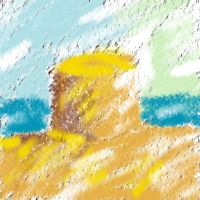
sandcastleImagine you walk onto a beach. You see this sandcastle. Now the sandcastle has clearly emerged from the sand around it. It is made of the same stuff. You don’t think: ‘Oh someone brought it from their car and put it there’. But neither could you think: ‘This is something that happened by chance’. It is fairly obvious that an external force, probably in the form of a child with a bucket and spade, came and forced the emergence of the sandcastle from the beach. Even a natural sandy object, such as a dune, is formed by wind and sea. So there has to be external influence for emergence to happen.

In the human mind we start with the genetic code. This amazing blueprint starts us off and lays the outline of who we are. But then, of course we have our nine senses. Now, until just over a year ago, I thought we only had 5 and I’m forever in the debt of The Rev. Shaun Lambert for pointing out the extra four. Altogether, they are:

  1. Sight
  2. Hearing
  3. Taste
  4. Touch
  5. Smell
  6. The awareness of inside our own body.
  7. The awareness of our own thoughts
  8. The awareness of the awareness of our own thoughts
  9. The sense of the presence of God.

Number 6 is fairly obvious. I’m sitting here thinking that I might want to go and visit the loo (that’s the bathroom to everyone on the other side of the Atlantic). If this feeling becomes strong enough I will get up and walk down the corridor. This sense is not always reliable. I can fool myself into thinking I’m hungry quite easily. Sportsmen and dancers develop this sense to an extraordinary degree.

Number 7 is also quite easy. We are aware of our own thoughts. Mostly we ‘hear’ them as a verbal stream. My best and most creative thoughts are usually pictures or diagrams and I can ‘see’  these ideas and reproduce them in the outside world. Each one of us can do this in different way because we can ‘sense’ our own thoughts.

Sense number 8 is an awareness of our awareness. This is a bit like listening in on a conversation. I’ll give you an example:

A few weeks ago I felt I had far too much to do at work. Then I had an e-mail asking (well telling) me to do some more things. At this point I got quite annoyed and started an internal stream of thought telling myself that I could not do any more and he needed to stop being so bossy. I was aware of all of this using sense 7. This went on for a while. Then sense number 8 began to become aware of this stream. It looked at these thoughts and found them childish and petty. This dampened down my annoyance enough to give me time to think that my manager was also under pressure and was generally a reasonable person and I needed to find a way to resolve this without making the problem worse.

This is clearly a good outcome but it can easily go the other way. Naturally, we tend to think our own thoughts are reasonable and our awareness of them will reinforce this. Sense 8 is not always good at distinguishing between healthy, positive thoughts and thoughts which will damage us. Which brings us to..

Sense 9: The awareness of the presence of God. I would say that almost all human beings have this sense, otherwise how would we know the difference between beauty and ugliness? Unless the ugliness threatened us in some way it would all be just the same. Just as there are people who lack the sense of sight or hearing there will be people who literally cannot sense God. But, I suspect, this is fairly rare. From time to time those of us who have faith have a pure sense of God, unconnected with anything else but He seems to work most effectively with Sense 8. St Paul puts in very well:

We demolish arguments and every pretension that sets itself up against the knowledge of God, and we take captive every thought to make it obedient to Christ.

2 Corinthians 10:5

Because, of course, God must be invited into our thoughts, just as we must open our eyes to see.

So, how does this work? How do we take captive our thoughts? I’ve drawn the diagram below to try and explain.

Thoughts

The black line is the outside of our mind. The gaps are where our senses meet the outside world. The coloured areas are the parts of our brain which interpret these experiences. The blue arrows represent the process going on in the everyday story earlier in this blog. I see (by reading e-mails)  and hear instructions to do certain tasks. These trigger certain thoughts which borrow the hearing interpretation area to become a verbal stream. I then become aware of these thoughts and invite God in by prayer to help me resolve the situation. The awareness of God influences this self awareness to bring me to a slightly different outcome from that which I would have reached on my own. This outcome is then sent back to the hearing interpretation area to become another verbal stream which becomes part of the conversation I have with my manager.

So consciousness emerges from the input of all these senses working on the substance of the brain. The only mystery in all of this is how we ‘hear’ God. Nagel suggests that matter, all matter has a protomental aspect. This is fairly close to Lewis’ idea that all matter is somewhere between the purely physical and the divine, that we are (to quote Lewis again) half Angel, half animal.

And these are not just philosophical ideas. Modern brain imaging techniques allow us to see different parts of the brain working as we think. And, as shown in ‘How God Changes your Brain’ (see previous blog post) faith in God really does change the structure of your brain, grows and shrinks different parts. And this awareness of God makes us aware of certain values outside our own needs and desires. Which brings us very neatly to the final part of Professor Nagel’s book. But I’m going finish this post now and leave that discussion for the next one.

If you want to contact me directly then please fill in the form below.

← Back

Thank you for your response. ✨

Some more useful reading:

A (fairly) easy book about how the brain works:

‘A Users Guide to the Brain’ – John Ratey

Still the best book about ordinary people’s experiences of God (unless you know better) is:

‘The Varieties of Religious Experience’ – William James

Please leave your comments here:

Miracles – C. S Lewis and How God Changes Your Brain – Andew Newberg and Mark Robert Waldman

For me the brain is a mystery. Ever since I was a teenager I wanted to know about this strange jumble of nerves and chemicals, electrical impulses and blood that somehow results in what we think, who we are, what we decide. Twenty years later I became a Christian and the mystery deepened. Where did God fit into all of this? Were my vivid experiences of God a part of me or a part of something else?

In very different ways these two books attempt to address this issue. I have to admit I was quite excited about reading ‘How God changes your brain’. Opening up the brown package I expected to get real answers to my questions. And, in a way I did. It explains in detail the way that spiritual practice changes the function and structure of the brain. That faith, and the practice of faith calms the primitive side of us and turns up the more altruistic, empathic side. It explains that prayer and meditation can cause us to become not only less selfish but to loose our sense of self altogether. Heady stuff. Or not. Because at the core of this book is an evasion. I find it incredible that two people can spend years researching the subject of God and still not recognise His reality. Towards the end of the book Andrew Newberg says the following:

‘For those who embark on a spiritual journey, God becomes a metaphor reflecting their personal search for truth. It is a journey towards self-awareness, salvation or enlightenment, and for those who are touched by this mystical experience, life becomes more meaningful and rich.’

And for those of you who are thinking: ‘This must really mean something profound but I just don’t get it’, don’t worry it really is meaningless. Newberg and Waldman are clinging onto the Naturalistic world view for all they are worth, almost hanging on by their fingernails. Also, it is profoundly patronising for people of faith. The suggestion, which is repeated throughout the book, is that God is not actually real.  On the final page of chapter 11 (Miracles pp150) C. S. Lewis describes the dillemma:

‘It is always shocking to meet life where we thought we were alone. ‘Look out!’ we cry, ‘it’s alive’. And therefore this is the very point at which so many draw back – I would have done so myself if I could – and proceed no further with Christianity. An ‘impersonal God’ – well and good. A subjective God of beauty truth and goodness, inside our own heads – better still. A formless life-force surging through us, a vast power we can tap- best of all. But God himself, alive, pulling at the other end of the cord, perhaps approaching at infinite speed, the hunter, King, husband- that is quite another matter… There comes a moment when people who have been dabbling in religion (‘Man’s search for God!’) suddenly draw back. Supposing we really found him? We never meant it to come to that! Worse still, supposing He had found us?’

And yet HGCYB is a book with a great deal of useful information. Much of the focus of it on the practice of meditation, and how this can improve our emotional and mental health. This is an area the mainstream church has ignored. I think there is a certain fear that we may stray into Eastern or even ‘New Age’ practices. This could be the case if the focus of our meditation is internal (as with Buddist meditation)  but if we focus on God, to look outside ourselves to the divine, we will not fall into this trap. Another argument against using meditation as part of spiritual practice is that it is not mentioned by Jesus in the Gospels. This is true, but the reason for this could well be that He didn’t need to. I did a quick search of the Old testament for the words Meditate and Meditation. They came up 18 times in the Psalms alone. I like this one:

‘Within your temple, O God,
we meditate on your unfailing love.’ – Psalm 48 v 9

This, and the other verses, were something all his audience knew. Only we have forgotten.

So, how does this work? Well, about a year ago I started to pray using a form called the ‘Jesus Prayer’. As this involves actions as well as words I’ve tried to draw it below:

Jesus Prayer

The words are: ‘Lord Jesus Christ, Son of God. Have mercy on me, a sinner’. This is a very old prayer, from the 4th or 5th Century. The prayer is silent. The up stroke in the picture represents a breath in (try to breathe from your stomach, like a singer) and the down stroke a breath out. The traditional way to use this prayer is to find a quiet place, a relaxed position (I like to lie down but there is a danger of falling asleep) and say this prayer between 10 and 20 times. This may be quite difficult at first but it is worth persevering. As you continue you will find any worries fading and the barriers between yourself and God falling away. After a while God will become clearer and He will start to communicate. This may be a feeling of peace, or a great inrush of the Holy Spirit. Sometimes I am prompted to pray quite simply for people I know who are in need.

I taught this prayer to our bible study group and about two thirds of them began to practice it. One couple, who were suffering from  health problems prayed it to help them relax enough to sleep. Another lady decided she didn’t like the words and used the same breathing technique, but on the words of the Lords Prayer. I have used it in all sorts of stressful situations, even in the middle of meetings. It doesn’t always solve the problems, but I feel so calm it doesn’t matter!

C. S. Lewis takes the role of the brain in relation to God and takes a completely different tack. HGCYB sees God as a product of the Brain. Lewis sees the brain as an spearhead or incursion of the supernatural into the natural world. The argument goes something like this:

  • The ability to reason is completely unlike the rest of the natural world.
  • Also the notion of right and wrong (even when it does not benefit the individual concerned) is so strong in Human Beings.
  • Therefore it must come from outside the natural world.
  • Therefore there must be a super nature outside of nature that has created this ability.

He says:

Human minds, then are not the only supernatural entities that exist. They do not come from nowhere. Each has come into Nature from Supernature: each has its tap-root in an eternal, self-existent, rational Being, whom we call God. Each is an offshoot, or spearhead, or incursion of that Supernatural reality into Nature.

I’ve tried to illustrate this below. On this 2D picture I’ve shown God on one side and Nature on the other with the two meeting within the Human mind. But it is more like a mingling or layering. Lewis talks of another dimension. I think it would be more accurate to talk of another sense. For a number of years I lost my sense of smell. I can well remember the day it came back. Just the smell of bacon was like a whole extra layer of reality in the world. Experiencing God is like that only bigger; a whole extra sense of reality.

brain2

Before we move on to more of Lewis’ ideas about Nature and God I think it is worth pointing out that this is not a particularly easy book to read. This is not because of the language or style (which, as you can see from the extracts is rather elegant) but because of the time in which it was written. Like most books of Christian thinking it is arguing against the prevailing thinking of its day.

But ‘Miracles’ was published in 1947. This is before the theory of the Big Bang, before Global Warming (well it was happening but no-one realised it), before chaos theory or butterflies flapping their wings in China. The universe seemed a very safe predictable place. David Hume could argue without a trace of irony that miracles could not happen because it was simply so unlikely that nature could be any different tomorrow from what it was today; so improbable, that it was impossible to believe. And Lewis needed to have a counter argument to this.

But the chapter ‘On Probability’ is the last one that the reader will need to make allowances for. From then on Lewis launches into a glorious and completely unapologetic exploration of the Miracles of the New Testament. Starting with the primary miracle of the incarnation of God in Jesus Christ. Today, even Christians don’t like to examine miracles too closely. I have tried to lead discussions on the physical nature of miracles and been constantly deflected into their emotional and religious significance. But Lewis meets this challenge head on. He describes miracles as being like God reaching down directly into the world. Our God is the creator, the god of nature as well as supernature. So every birth is His work, but through the medium of the biological process. In the conception of Jesus he dispensed with the mechanism of biology and reached directly into the womb of a young Jewish girl at her prayers. Following on from his argument that each one of us has a ‘tap root’ of God within us he says:

We cannot conceive how the Divine Spirit dwelled within the created and human spirit of Jesus but neither can we conceive how His human spirit, or that of any man, dwells within his natural organism. What we can understand, if the Christian doctrine is true, is that our own composite existence is not the sheer anomaly it might seem to be, but a faint image of he Divine Incarnation itself – the same theme but in a very minor key.

So, in all miracles there is a fusion of the natural and supernatural. And in this way they are physical prophecies, precursors of a ‘New Nature’. ‘There will be no room to get the finest razor blade of thought between Sprit and Nature’ says Lewis. I think we see this at work in the Gospels many times. In the feeding of the five thousand;

“Bring them here to me,” He said. And he directed the people to sit down on the grass. Taking the five loaves and the two fish and looking up to Heaven, he gave thanks and broke the loaves. Then he gave them to the disciples, and the disciples gave them to the people. – Matthew 14: 18-19

At some point during the bread and fishes acquired a new spiritual reality. They were still loaves, still fishes, still could be eaten and digested, yet Heaven had entered that bread at that moment of giving thanks. I wonder what it felt like to eat that bread? Were those people changed by it?

But there is one thing I need to disagree with Lewis on. In many places he says that this fusion of God’s Spirit and Nature happened at one time in history. Even reading the bible this is clearly not true. There are many instances of this happening in Acts. But does this still happen today?

The answer is ‘Of Course it does’. Even among the Christians I know I can think of many instances. It is almost commonplace. But, as this is a blog rather than an academic discourse I’m going to describe something that happened to me last spring:

At the beginning of 2012 I found myself in a difficult place. I felt I was stalled in many areas of my life. My work was not going well, I seemed to be sleepwalking through both my Church and home life. During this time I had a vivid picture in my mind of being in a dark wood, surrounded by brambles and thorns. Gradually, as the days grew longer, the picture changed and I seemed to be coming to the edge of this wood. Through the brambles I could see a bright green hillside. Then the changes to the picture in my mind stalled. I was standing on the edge of the beautiful hillside; there was nothing stopping me from walking forward but I couldn’t and I could still see the brambles and thorns on the edge of my vision.

Then I became aware of God asking me to make a journey. Now this happens from time to time. The journeys are not usually very long, sometimes just to the other side of the room. The furthest I’ve ever been asked to go is Oxford (about 40 miles away). In this case it was to climb to the top of the hill near our house. Now this was not an unreasonable or difficult request but, for a few weeks, I kept on putting it off. Finally, I put on my walking boots (It’s quite a steep climb), packed my paints, and walked out of the house and up the hill.

Hillside

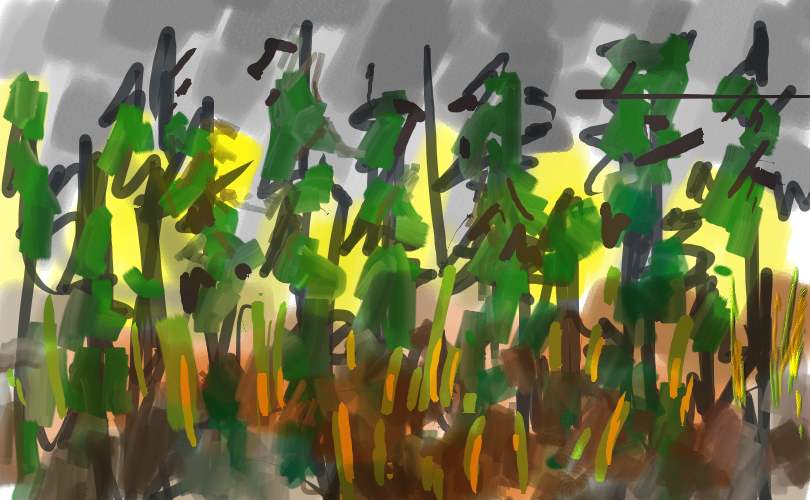
As I reached the top I began to realise that the landscape was actually the picture in my mind. To my right was the wood, full of brambles and thorns. To my left was a bright green hillside with wild flowers and little bushes in the distance. I sat on a bench and painted the picture you can see here. Then I packed away my paints and walked forward away from the dark wood.

It was at this point that the extraordinary thing happened. The ground under my feet seemed to have two distinct realities. It was still physical ground but it also had a spiritual reality that was hovering slightly above the solid ground. This spiritual ground was slightly luminous and even brighter than the grass in the spring sunshine. I wish now that I had been paying more attention. What was I actually walking on? If this had been water rather than ground could I have walked on it, like Peter and Jesus? I don’t know. Because what I was most aware of was a tremendous sense of peace and joy. The walk across that hillside was also a walk away from the brambles and thorns into a more positive future. I felt physically very strong and light, as though it took no effort at all to make that walk.

For someone like myself, with a scientific education, such an experience raises more questions than it answers. But I know it was not a dream or an illusion. If anything, it was more real than my everyday existence and has had a profound and lasting effect on my life. But I am going to leave the last word to Lewis:

But Christian teaching, by saying that God made the world and called it good, teaches that Nature or environment cannot be simply irrelevant to spiritual beatitude in general… By teaching the resurrection of the body it teaches that Heaven is not merely a state of the spirit but a state of the body as well: and therefore a state of Nature as a whole. Christ, it is true, told His hearers that the kingdom of Heaven was ‘within’ or ‘among’ them. But his hearers were not merely in ‘a state of mind’. The planet He had created was beneath their feet, His sun above their heads; blood and lungs and guts were working in the bodies He had invented, photons and sound waves of His devising were blessing them with the sight of His human face and sound of His voice… From this factor of environment Christianity does not teach us to desire a total release. We desire, like St Paul, not to be un-clothed but to be re-clothed: to find not the formless Everywhere-and-Nowhere but the promised land, that Nature which will be always and perfectly- as present Nature is partially and intermittently – the instrument for that that music which will then arise between Christ and us.

← Back

Thank you for your response. ✨